Friday, 15 August 2014

Writtle Wildlife Watch (July 2014)

Welcome back to the latest Writtle Wildlife Watch! We hope you have all been enjoying your summer. Conservation expert, Alan Roscoe, writes about the latest wildlife he has spotted on campus.

------------------------------------------------------------------------------------------------------------------

Have you ever noticed that when you see an animal or bird for the very first time, you then begin to see it almost regularly, despite the fact you have never encountered it before? Isn’t that strange? And before anyone else jumps in, I am claiming this phenomenon as ‘Roscoe’s Rule’.

Stoat image: Wikipedia "Mustela erminea upright"
by Steve Hillebrand, USFWS
Rather curiously, this appears to be happening on the College’s main campus area with two species in particular suddenly popping up everywhere. Grass Snake is definitely moving into areas it has not been seen before and the impressive size of the females makes for some exciting sightings for students around the campus gardens.

But the real crowd pleaser has been Stoat which, over the past year or so, has also been plucking up courage and moving further onto the main campus. I have certainly seen more Rabbit recently and my suspicion is that the Stoats are simply following their prey. In fact the latest sighting was last week when a colleague heard a Rabbit squealing in a distressed manner at the sight of Stoat (well you would, wouldn’t you?) although he tells me the result was Rabbit 1 Stoat 0. 

Relatively speaking, Stoat has what is known as a wide ‘ecological amplitude’. In other words, it displays an ability to adapt to a wide range of environmental conditions. For this reason, it is found throughout Britain although an individual animal will not usually survive beyond its second year. And a curious anomaly: Stoats are legally protected in Ireland but not in the UK.

Please also follow us on Twitter @WrittleCons.

Thursday, 3 July 2014

Writtle Wildlife Watch (June 2014)


Writtle Wildlife Watch returns for June! Alan Roscoe is at it again and once more keeps track of the fascinating wildlife on campus! 

--------------------------------------------------------------------------------------------------------------

I hope most of you caught up with the recent Springwatch programmes from Minsmere. Apparently the visitor numbers were up a staggering 50% as a result of the TV coverage although you do have to wonder whether the additional visitors were more excited about seeing Chris Packham than the wildlife!

It is good to see the BBC committing so much resource to programmes like this although (curmudgeonly grouch face on) just occasionally I wonder whether there is an overemphasis on the birds and the mammals – which, of course, the public enjoy – at the expense of the plants and other groups such as lichens and mosses. These are just as fascinating as the popular animal groups but, perhaps because they do not move, they are less appealing to the general public.

Pyramidal Orchid, Writtle College estate,
26 June 2014, Copyright Alan Roscoe.
We monitor a range of animal species on our own College estate but we also keep an eye open for unusual plants and now is the best time of year for many orchid species. We are lucky enough to have both Bee Orchid and Pyramidal Orchid on our estate and, due to the sharp eyes of a colleague (well spotted Roy), we have found a new site for them this year. Pyramidal is pollinated by moths and butterflies which visit the plant not for nectar, but for a watery liquid which is found inside the ‘spur’ part of the flower. Grains of pollen are then picked up on the insect’s tongue and the perfect symbiosis of this particular species and its pollinating insects was even remarked upon by Charles Darwin himself. 

Please also follow us on Twitter @WrittleCons.

Tuesday, 1 July 2014

Tour de France comes to Essex!


The Tour de France is coming to Essex on Monday! Its route takes the riders past Writtle College and we are extremely excited by this event, especially as we now have a brand new Foundation degree in Cycling Performance* in our portfolio! Our course manager for Sports and Exercise Performance programmes, Mark Walker, recently featured on Youth Cycle Sport  discussing the new cycling degree! Take a look at the article below!

-------------------------------------------------------------------------------------------------------------------

Mark Walker is course manager for the new Foundation degree in Cycling Performance* at Writtle College. A senior lecturer in sports and exercise performance at the College for the last seven years, he provides coaching support to some of the top GB cyclo cross riders, including European Cyclo-Cross Champion Helen Wyman, emerging star 17-year-old Sean Dunlea - who is a student at the College - and multiple national champion Hugo Robinson. Here he explains why now is the right time to launch a cycling degree, what the course involves and its unique mode of delivery, which gives students the chance to pursue their coaching or competing ambitions while studying.
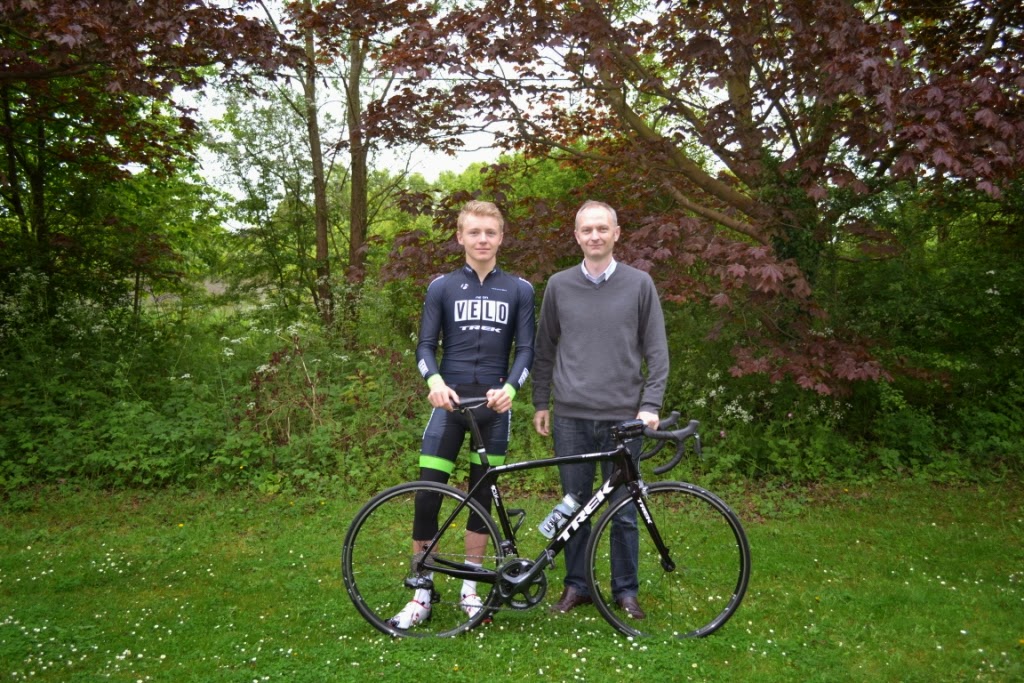
Mark Walker (right) with cyclist Sean Dunlea
"The idea for this new degree came from the fact that I've been undertaking physiological tests on a number of cyclists in the sports laboratory at Writtle College who have faced the dilemma of whether to continue in education when they leave school or try to become a professional cyclist or coach. This is clearly a really difficult decision and it creates lots of conflicts in their lives. Some of them choose not to pursue their education and to dedicate their time to being a pro as it's such a small window of opportunity but it causes stress as they know very few people succeed. It's obviously good to have a fall-back position and their parents, knowing the risks, find it concerning if they give up education altogether. With the growing interest in cycling, we thought we could put together a degree that is taught in a flexible way so those in this position can continue with their studies but also balance their training or racing commitments. 

The course is a Foundation degree as this has a work-based focus and is more vocational than an Honours degree. The students spend 25% of their time in industry. Our model is that students spend September to February in College studying, with intensive teaching in February. They then carry out work experience in the summer months - coaching, cycling development, working in any facet of the cycling industry they are interested in or, if they are a competitive cyclist, they can race and train while it contributes towards their assessed work experience. During this time, there is an element of distance learning to the degree - they continue with their formal modules online - so we're really trying to make it as user-friendly as possible for these students. 

The Foundation degree has modules to complement coaching such as coaching strength and conditioning, exercise physiology, nutrition, along with a large element being about the cycling industry and careers in the industry. We have a fully-equipped sports lab here, which has a strong focus on cycling science - measuring power outputs of cyclists with SRM and 10 power tap wheels - and the physiological demands on the cyclists. 

With the industry-focus of the degree, students can really think about their future career direction and we can facilitate it so they have the career they want. We have a huge number of contacts in the industry - the Olympic velodrome, Hadleigh Farm, Braintree BMX Club, local coaches, physiotherapists and the professional cycling team - which can help students gain the work experience they need. The professional cycling team in particular can give students a unique and valuable insight into the roles of staff and what it's like for riders on the team. 

It is an exciting time in the industry. When I was a youngster there wasn't an obvious way into cycling. But with British Cycling there is now a clear structure and route into coaching. We are offering a coaching qualification as part of the degree so we can give students the best chance of being able to step into a career after successfully graduating. We envisage our students embarking on carers in cycling development, coaching, team management, retail - the biomechanical side of the market is really growing - and competitive cycling. Although the degree is based purely on cycling, students will also be able to progress onto the more generic Sports and Exercise Performance Honours degree at Writtle College - the Foundation degree in Cycling Performance will count as the first two years so all they need to do is to study for another year to get a more general sports science BSc. This opens up doors in sport generally and they could go onto physiotherapy qualifications or teaching qualifications, for example. This means, on graduation, they can boast a Sports Science degree with a unique focus on cycling, which should put them in a strong position. 

We carried out market research on Twitter to gauge demand for the degree. Within two days we had 200 respondents to our online survey, so this gives an idea of the level of interest in the programme. As a result of this feedback, we have broadened the scope of the degree. At first we thought the degree would mainly appeal to those who have just completed school or National Diplomas but we found there was a demand from older students who were saying that they wanted a career change in their late 30s or 40s and they were interested in pursuing a cycling course. These were people who could already have a qualification from British Cycling but wanted to learn the underpinning sports science. There is a parallel to what I did - I trained in engineering, bio-technology, as an undergraduate and then did my Masters in my early 30s and pursued a career in sports science and as a cycling physiologist. That came from a passion in cycling and sports science as a youngster so I can empathise!

Cycling is thriving off the back of the Olympics and the Tour de France, with the success of Bradley Wiggins and Chris Froome. The Women's Tour has gained a raised profile through the success of competitors such as Marianne Vos and the UK held the European Cyclo Cross championships in 2012. Alongside this, there's been a big push by the Department for Transport for active transport for good health and environmental reasons. All of this has led to an enormous growth in the popularity of the sport and many more people are racing recreationally. The College is already really well-known in the cycling community as we have hosted cycling events here such as the Eastern Region Cyclo Cross Race and rounds of the Mud, Sweat and Gears mountain biking contest. We have held, with British Cycling, coaching days for women's cyclo cross and an eastern region cyclo cross conference, all with the help of Mark Wyer from British Cycling. This momentum is continuing with the Tour de France visiting the UK this year and coming past Writtle College. With the London velodrome only 40 minutes away from us, along with Hadleigh Farm in the county, Writtle can capitalise on being in the midst of this action and we hope to develop the College as a hub for cycling expertise. All this makes it the right time to launch a programme like this and I am really excited to be bringing it to Writtle College."

Take a look at the course here: http://writtle.ac.uk/Foundation-Degree-(FdSc)-Cycling-Performance

*subject to validation

Tuesday, 17 June 2014

Writtle Wildlife Watch (May 2014)

Writtle Wildlife Watch is back! Once more, our conservation expert Alan Roscoe has been keeping an eye on the wildlife on campus. 

--------------------------------------------------------------------------------------------------------------

"Personally, I am not a great one for cute and fluffy animals. Giant Panda? Thanks but no. Meerkats? Raincheck. Ring-tailed Lemur? Sorry, washing my hair.

But every once in a while you have a close encounter with the cute and fluffy side of nature that really hits home. Back in the January blog I mentioned our various bird boxes around the estate and I am delighted to report we have a newly hatched clutch of College Kestrels this month, having only installed the box earlier this year.

Kestrel box at Writtle College. Copyright Steve Baines.
Under the supervision of local bird box supremo Steve Baines, the box was checked a few days ago and we have five very healthy looking chicks. As you can see they are quite chunky already but also a little apprehensive of strangers! We checked but the mother was nowhere to be seen. You have to be patient as absences from a nestbox can be as long as two hours.

And in line with this blog’s mission to be both entertaining and informative, Kestrels number some 45,000 pairs in Britain, although they have declined recently leading to ‘amber’ status. The word ‘falcon’ derives from the Latin falcis meaning a sickle, and refers to the shape of a falcon’s talons. Now there’s a good word I never learned in my Latin lessons."

For those of you on Twitter, did you know you can now follow us? Find us @WrittleCons.

Tuesday, 29 April 2014

Writtle Wildlife Watch (April 2014)

Writtle conservation expert, Alan Roscoe, has once again been observing the wildlife on campus at Writtle. Here, Alan reviews his April findings.

--------------------------------------------------------------------------------------------------------------

"Now come on, this just isn’t playing fair. One second you think the rain has gone and we are in for another scorching summer like last year, the next you are gazing out of the window, whilst reaching for the thermostat.

But did you notice the slightest warming of the days a few weeks back when things started waking up? We certainly did here at the College as we are interested in annual changes in seasonal events (’phenological indicators’) and our students keep an eye open for us on the first appearance of certain key species, especially butterflies.

Orange Tip, College estate, April 2014, Copyright Noah Greaves
So, what was the first butterfly out of the blocks this year? The Brimstone was the first species, spotted in late February by our student Fiona basking on bricks near the student restaurant (the butterfly that is, not Fiona). This sulphur yellow insect was closely followed by Peacock, Small Tortoiseshell and Comma. But for me the acme of spring is the Orange Tip. This small butterfly says that spring is in full swing and its appearance is all the more special for it being so fleeting.


Thanks to our student Noah for this great picture of a female Orange Tip on the College estate. Roll on summer."

Monday, 31 March 2014

Writtle Wildlife Watch (March 2014)

This month our conservation expert Alan Roscoe discusses the recent installation of an Otter Holt by Writtle students as well as his own encounter with the species.

-------------------------------------------------------------------------------------------------------------------

All animals are fascinating but, let’s face it, we tend to have softer spots for certain species. Of course it helps if it is a mammal – we can empathise with that group – and if you can add in a dash of success against the odds you can end up with a very charismatic species. One such animal is the Otter which has fought back from catastrophic losses in the middle of the 20th century and is now found in every county in England. 

Otter (Image by Catherine Trigg. Source: Flickr)
Students found spraints on the College estate in 2010 and they have also been reported along the River Wid in nearby Writtle village by our friends in the village wildlife group. The otters continue to spraint under one of our bridges and this year we thought we would lend them a hand.

We have regular work parties on the estate and a good project for a pleasant spring day is building an otter holt. Otters will use artificial holts if sited in undisturbed areas and, despite the fact we have a very busy estate, animals can still find quiet corners away from farm and student activity.

I invited students to run the activity as projects like this provide an opportunity to demonstrate planning, resourcing, organisational and management skills. Will and Katy volunteered to look after everything and off we went. The day passed surprisingly quickly and after just three hours we had a very substantial holt (see picture below). I am hoping we can set up our remote camera soon to capture any activity. 

Writtle students with Otter Holt
An added bonus: the timber we used had been brought down by our students elsewhere on the estate as part of felling practice so we also had a perfectly sustainable activity.

Just a footnote: Otters may look cute and cuddly but they are actually very chunky animals. Apologies for ending on a sad note but I came across a dead otter on one of Chelmsford’s main roads two years ago. I arranged with a contact at Essex Wildlife Trust to have it sent away for a post mortem but it was up to me to recover the animal. It was immensely heavy and this was of course, compounded by the fact it was dead weight. I managed to wrestle the body into the boot of my car and, nose to tail, it stretched right across the boot.

So, sadly, they will continue to be the victims of accidents but we have high hopes for our local animals and, with any luck, we shall have residents soon.


Monday, 10 March 2014

Writtle Wildlife Watch (February 2014)

Writtle Conservation lecturer, Alan Roscoe, updates us on his latest 'Writtle Wildlife Watch'.

"A couple of months back I mentioned the recent storms and flooding but such has been their impact I feel I have to mention them again before Spring arrives.

Clearly you don’t have to live on the Somerset Levels to be aware of the potential for damage and even here, in warm and sheltered Essex (where the sun shines every day!) we have had some clearing up to do. This week we were out with our first years clearing away some trees which had come down across the green lane which crosses our estate just to let local residents and horses through.

UK floods in 2014
There has been much debate on comments pages attached to BBC website news stories with many contributors. And, yes, I am among them – see if you can spot my comments! Unfortunately, to paraphrase Mrs Merton (c.1997), many people seem to have taken the story as an excuse for a ‘heated debate’. But apart from the rather predictable ‘I blame the farmers / RSPB / Environment Agency / insert name of enemy here’ comments, there have also been some really interesting observations about the root causes of flooding, the nature of our countryside, what we expect from it and how to mitigate – and I cannot, hand on heart, say ‘avoid’ – such significant floods in the future. The most recent piece on the subject is at:


Perhaps now is the moment when we have that national (unheated) debate about our competing demands on our countryside, its aesthetics, its purpose and its future."